
What Is a Metaphor for Mystery?
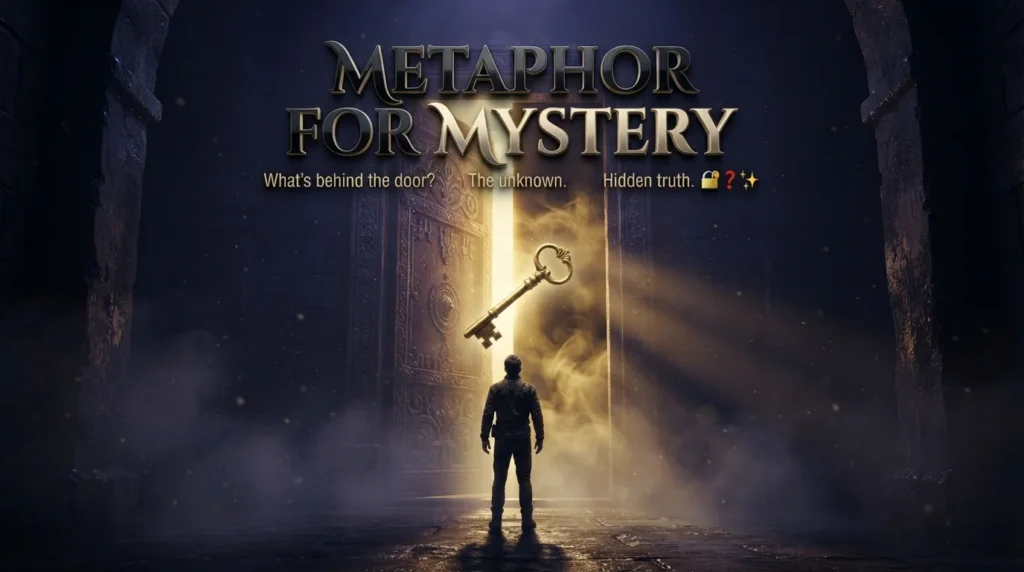
A metaphor for mystery directly compares something unknown or unexplained to a familiar object, place, or experience.
For example:
“The mystery was a locked door.”
The mystery is not literally a door. The locked door represents something hidden that cannot yet be understood.
Simple Definition
A metaphor for mystery describes the unknown, secrecy, uncertainty, or unanswered questions through a vivid image.
What Can Mystery Represent?
Mystery can symbolize:
- The unknown
- Secrets
- Uncertainty
- Hidden truth
- Curiosity
- Fear
- Suspense
- Discovery
- Confusion
- The unexplained
Best Metaphors for Mystery
| Metaphor | Meaning |
|---|---|
| Mystery is a locked door. | Something hidden and waiting to be discovered. |
| Mystery is a fog. | Something unclear or difficult to understand. |
| Mystery is a puzzle. | Something that requires clues and thought to solve. |
| Mystery is a maze. | Something confusing with an uncertain path. |
| Mystery is a shadow. | Something hidden or difficult to see clearly. |
| Mystery is a closed book. | Information that remains unknown. |
| Mystery is a black box. | Something whose contents or workings are unknown. |
| Mystery is a veil. | Something concealing the truth. |
| Mystery is an unopened letter. | A secret waiting to be revealed. |
| Mystery is a deep ocean. | Something vast and largely unexplored. |
Metaphors for Mystery as Something Hidden
Mystery Is a Locked Door
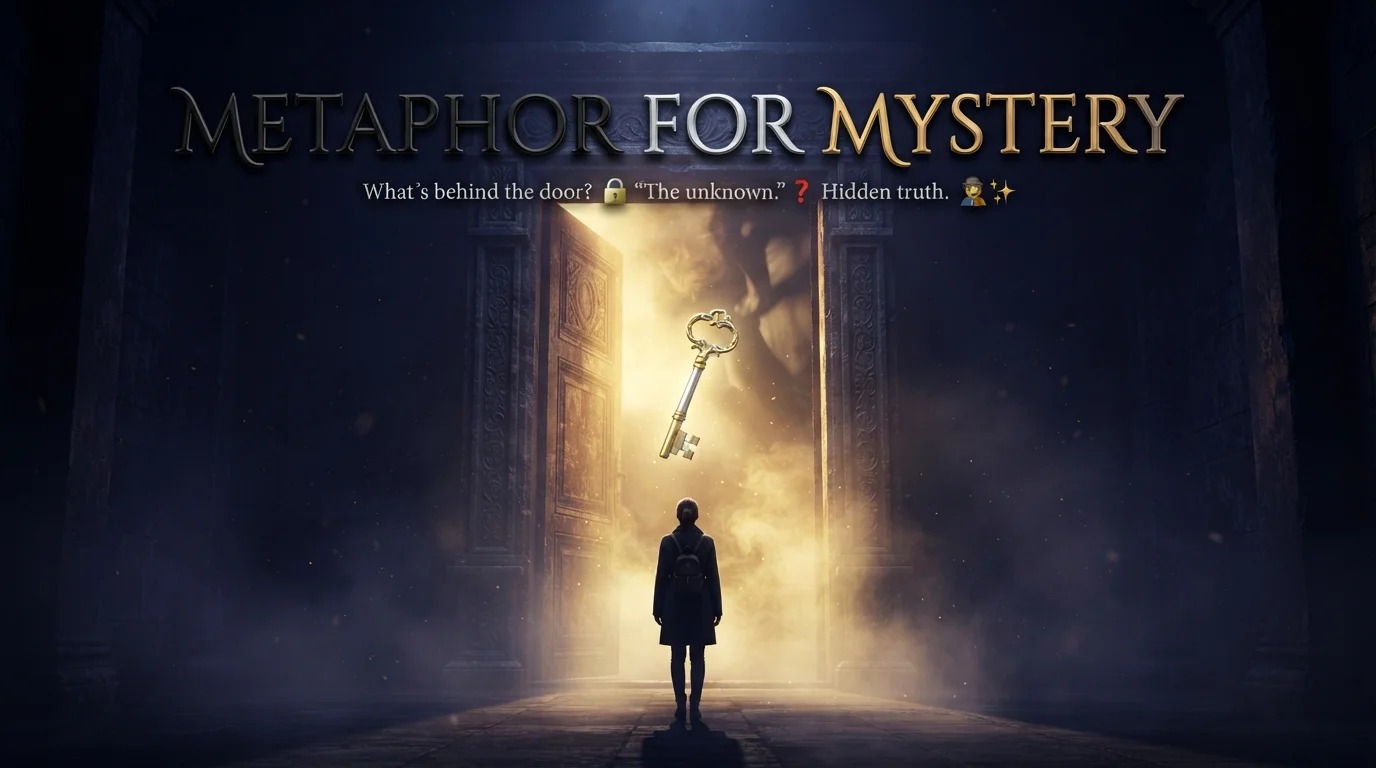
“The mystery was a locked door, daring her to find the key.”
This is one of the clearest metaphors for mystery. The locked door represents hidden information, while the key represents the answer.
Mystery Is a Veil
“A veil of mystery covered the truth.”
The veil represents something that hides what is underneath.
Mystery Is a Closed Book
“His past was a closed book.”
This metaphor suggests that information about someone’s past remains unknown or inaccessible.
Metaphors for Mystery as Something Unclear
Mystery Is a Fog
“The truth was hidden in a thick fog of mystery.”
Fog makes it difficult to see clearly, so it is a natural metaphor for uncertainty.
Mystery Is a Shadow
“A shadow of mystery followed the old house.”
The shadow represents something strange or unexplained that remains nearby without becoming fully visible.
Mystery Is a Cloud
“A cloud of mystery hung over the disappearance.”
This metaphor suggests uncertainty surrounding an event.
Metaphors for Mystery as a Puzzle
Mystery Is a Puzzle
“The case was a puzzle with half its pieces missing.”
This metaphor emphasizes the process of collecting clues and finding answers.
Mystery Is a Maze
“The truth was a maze, with every answer leading to another question.”
A maze represents confusion, complexity, and the difficulty of finding the correct path.
Mystery Is a Riddle
“The stranger was a riddle no one could solve.”
This metaphor suggests that the person or situation is difficult to understand.
Metaphors for Mystery as Discovery
Mystery Is an Unopened Letter
“The future was an unopened letter waiting to reveal its secrets.”
The unopened letter represents information that has not yet been discovered.
Mystery Is a Treasure Chest
“The ancient house was a treasure chest of mysteries.”
This metaphor suggests that many hidden discoveries may be waiting inside.
Mystery Is a Deep Ocean
“The human mind is a deep ocean of mystery.”
The ocean represents depth, complexity, and things that remain unexplored.
Poetic Metaphors for Mystery
For poetry, fiction, or atmospheric writing, these metaphors can create a stronger sense of suspense:
- Mystery is a locked door in the hallway of the unknown.
- Mystery is a fog hiding the road ahead.
- Mystery is a shadow that refuses to reveal its owner.
- Mystery is a whisper behind a closed door.
- Mystery is an unopened letter from tomorrow.
- Mystery is a moonless road disappearing into darkness.
- Mystery is a veil hiding the face of truth.
- Mystery is a key searching for a lock.
- Mystery is an ocean whose depths have never been fully explored.
- Mystery is a question standing patiently in the dark.
Simple Metaphors for Mystery for Students
If you need an easy metaphor for a school assignment, these are clear and memorable:
- Mystery is a locked door.
- Mystery is a fog.
- Mystery is a puzzle.
- Mystery is a maze.
- Mystery is a shadow.
- Mystery is a closed book.
- Mystery is a veil.
- Mystery is an unopened letter.
- Mystery is a riddle.
- Mystery is a deep ocean.
Metaphors for Mystery in a Sentence
Example 1: Locked Door
The mystery was a locked door, and every clue seemed to bring her closer to the key.
Example 2: Fog
A fog of mystery surrounded the abandoned house.
Example 3: Puzzle
The disappearance was a puzzle, with each clue revealing another missing piece.
Example 4: Shadow
A shadow of mystery followed him wherever he went.
Example 5: Closed Book
Her childhood was a closed book, filled with stories she refused to tell.
Example 6: Maze
The truth was a maze, and every wrong turn created another question.
Metaphors for Different Types of Mystery
The best metaphor depends on the kind of mystery you want to describe.
| Type of Mystery | Best Metaphor |
|---|---|
| Hidden secret | Locked door |
| Uncertainty | Fog |
| Difficult problem | Puzzle |
| Confusing situation | Maze |
| Hidden presence | Shadow |
| Unknown past | Closed book |
| Concealed truth | Veil |
| Future uncertainty | Unopened letter |
| Complex mystery | Deep ocean |
| Strange person | Riddle |
Metaphor vs. Simile for Mystery
A metaphor makes a direct comparison, while a simile uses “like” or “as.”
| Metaphor | Simile |
|---|---|
| Mystery is a locked door. | Mystery is like a locked door. |
| Mystery is a fog. | Mystery is like a fog. |
| Mystery is a puzzle. | Mystery is like a puzzle. |
| Mystery is a shadow. | Mystery is like a shadow. |
Easy Way to Remember
Metaphor = direct comparison
Mystery is a locked door.
Simile = uses “like” or “as”
Mystery is like a locked door.
How to Create Your Own Metaphor for Mystery
Creating your own metaphor becomes easier when you first decide what kind of mystery you want to describe.
Decide What You Want to Show
Ask yourself:
- Is the mystery hiding something?
- Is it confusing?
- Is it frightening?
- Is it exciting?
- Does it invite discovery?
- Is it impossible to understand?
Choose a Matching Image
| Meaning | Possible Image |
|---|---|
| Hidden information | Locked door |
| Uncertainty | Fog |
| Confusion | Maze |
| Problem to solve | Puzzle |
| Secrecy | Veil |
| Unknown past | Closed book |
| Future uncertainty | Unopened letter |
| Fear | Shadow |
| Discovery | Treasure chest |
| Complexity | Deep ocean |
Make the Comparison Direct
Instead of:
The mystery is like a fog.
Write:
The mystery was a fog hiding the truth.
For a more poetic version:
Mystery was a fog that lifted one question only to reveal another.
Common Mistakes When Using Metaphors for Mystery
Making the Metaphor Too Obvious
A metaphor should create an image without explaining every detail.
Instead of:
Mystery is a thing that is unknown, like a locked door that hides something.
Write:
Mystery is a locked door.
Choosing an Image That Does Not Match the Mood
A fog works well for uncertainty.
A maze works well for confusion.
A locked door works well for secrets.
A treasure chest works better for exciting discovery.
Mixing Too Many Metaphors
Avoid:
The mystery was a fog, puzzle, maze, ocean, door, shadow, and book.
Choose one strong image:
The mystery was a maze, and every answer led deeper into the unknown.
Best Metaphor for Mystery
If you need one simple and versatile metaphor, “Mystery is a locked door” is an excellent choice.
It immediately creates the idea of something hidden and invites the reader to wonder what is behind it.
For uncertainty:
“Mystery is a fog.”
For a difficult problem:
“Mystery is a puzzle.”
For secrecy:
“Mystery is a veil.”
For complexity:
“Mystery is a deep ocean.”
For poetic writing:
“Mystery is a whisper behind a closed door.”