

What Is a Monetary Metaphor for One’s Opinion?
A monetary metaphor compares an opinion, thought, viewpoint, or piece of advice to money or something associated with financial value.
The simplest example is:
“Here are my two cents.”
This means:
“Here is my opinion.”
The metaphor works because an opinion is treated as something that can be contributed to a conversation, just as money can be contributed to a collection.
Why Are Opinions Compared to Money?
Opinions and money can both be described in terms of value. Some ideas are considered valuable, while others may have little influence.
An opinion might be:
- A small contribution
- Valuable
- Influential
- Worth considering
- Worthless
- Costly to ignore
- Priceless
This connection makes monetary language especially useful for describing ideas and perspectives.
The Most Common Monetary Metaphor: “My Two Cents”
The best-known monetary expression for giving an opinion is:
“My two cents.”
For example:
“If you want my two cents, I think we should wait.”
The meaning is simple:
“If you want my opinion, I think we should wait.”
Why Does “My Two Cents” Work?
The phrase presents an opinion as a small contribution. It often sounds modest, as though the speaker is saying:
“This is only my small contribution to the discussion.”
Examples of “My Two Cents”
- “Let me add my two cents.”
- “Here are my two cents on the issue.”
- “Everyone gave their two cents during the meeting.”
- “Before you decide, I would like to offer my two cents.”
For everyday conversation, this is the most natural choice.
Other Monetary Metaphors for an Opinion
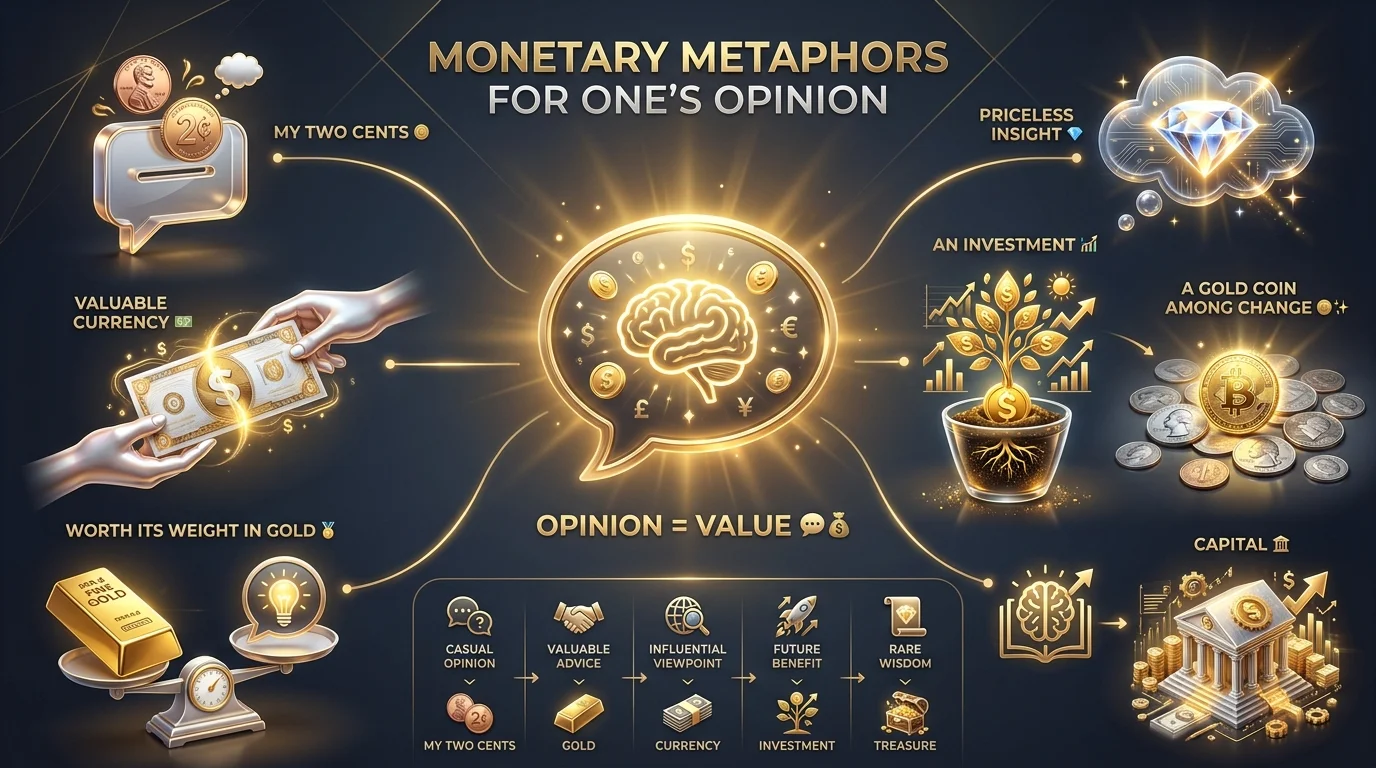
Not every opinion needs to be described as “two cents.” Different money-related metaphors can communicate different levels of value and influence.
| Metaphor | Meaning | Best Use |
|---|---|---|
| My two cents | My opinion | Casual conversation |
| Worth its weight in gold | Extremely valuable | Wise advice |
| Valuable currency | Important or influential | Discussions and debates |
| A gold coin among change | More valuable than other ideas | Creative writing |
| Priceless insight | Extremely valuable wisdom | Expert advice |
| An investment | Something that may bring future value | Long-term decisions |
| Capital | Value built through knowledge or experience | Professional writing |
Opinion as Currency
One creative way to describe an opinion is to compare it to currency.
“Her opinion was valuable currency in the conversation.”
This suggests that her viewpoint had influence and importance.
Currency is something people exchange because it has recognized value. In the same way, a respected person’s opinion may carry influence in a discussion.
Examples
“Experience made his opinion valuable currency in the meeting.”
“In the debate, good ideas became currency.”
“Her perspective was the strongest currency in the room.”
This metaphor works particularly well in speeches, essays, and creative writing.
Opinion as Gold
Gold is often used as a symbol of something rare and valuable.
“Her opinion was gold.”
This means her viewpoint was highly valuable.
A more descriptive version is:
“Her opinion was a gold coin among ordinary change.”
The contrast between gold and ordinary change makes the metaphor stronger.
Examples
“His advice was gold when I needed direction.”
“Her perspective was a gold coin in a conversation full of loose change.”
“Among dozens of opinions, hers shone like gold.”
Opinion as an Investment
An opinion can also be compared to an investment when listening to it may bring future benefits.
“Listening to her advice was an investment that paid off.”
This metaphor suggests that time spent considering her viewpoint eventually produced something valuable.
Examples
“His advice was an investment in a better future.”
“Taking her perspective seriously was an investment that paid dividends.”
This comparison works especially well when an opinion leads to a successful decision.
Opinion as a Coin
A coin is a small object with recognized value, making it a useful symbol for an individual contribution.
“She dropped a coin of wisdom into the conversation.”
This suggests that her contribution was small but valuable.
Other creative examples include:
- His opinion was a silver coin in the discussion.
- Her words were gold coins of experience.
- Each thoughtful idea was another coin added to the table.
- He offered a small coin of wisdom before leaving.
Monetary Metaphors for Different Types of Opinions
| Type of Opinion | Best Metaphor |
|---|---|
| Casual opinion | My two cents |
| Modest contribution | A small coin |
| Valuable opinion | Gold |
| Expert insight | Priceless advice |
| Influential viewpoint | Currency |
| Long-term benefit | An investment |
| Knowledge-based opinion | Capital |
| Rare wisdom | A gold coin among change |
Creative Monetary Metaphors for One’s Opinion
If you are writing a story, poem, speech, or essay, you may want something more original than an everyday expression.
Here are some creative examples:
- Her opinion was a gold coin dropped into the silence.
- His thoughts were currency in a room full of empty promises.
- Every word of advice was a coin minted from experience.
- Her perspective was gold in the marketplace of ideas.
- His opinion was a rare coin that no one wanted to spend carelessly.
- She carried wisdom like a pocket full of gold.
- Their opinions were coins scattered across the table of debate.
- Her words were an investment in a future she could not yet see.
- His perspective was treasure hidden inside an ordinary sentence.
- Her voice was gold in a room full of loose change.
Best Monetary Metaphors for Essays and Formal Writing
Some expressions sound better in formal writing than others.
For an Academic Essay
Instead of “my two cents,” which is informal, you could use a creative metaphor carefully:
“Opinions can function as currency in the marketplace of ideas.”
This works well when discussing public debate or intellectual exchange.
For a Speech
You might say:
“Every voice adds a coin to the treasury of human understanding.”
This sounds more inspirational and poetic.
For Business Writing
A useful expression is:
“Her experience gave her opinion significant value.”
You can also use:
“Her judgment was one of the team’s most valuable assets.”
This connects opinions with business value without sounding overly informal.
“My Two Cents” vs. “Worth Its Weight in Gold”
These two expressions are related to money, but they serve very different purposes.
| Expression | Meaning |
|---|---|
| My two cents | My personal opinion |
| Worth its weight in gold | Extremely valuable |
| Valuable currency | Important and influential |
| A gold coin among change | A viewpoint that stands out |
| An investment | Something that may create future value |
Which Should You Choose?
Use “my two cents” when you simply want to offer your opinion.
Use “worth its weight in gold” when you want to show that advice is extremely valuable.
Use “currency” when you want to emphasize influence.
Use “gold coin among loose change” when you want a more creative and memorable image.
Metaphor vs. Idiom
The phrase “my two cents” is best known as an idiom. It is an established expression whose meaning is understood by native speakers.
However, it is based on a metaphorical idea: an opinion is treated like a small amount of money contributed to a conversation.
A direct metaphor would be:
“Her opinion was gold.”
Or:
“His perspective was currency.”
These directly compare an opinion with something valuable.
How to Create Your Own Monetary Metaphor for an Opinion
Creating your own metaphor is easier when you first decide what you want to say about the opinion.
Decide What the Opinion Represents
Ask yourself:
- Is the opinion valuable?
- Is it small or modest?
- Is it influential?
- Is it rare?
- Is it based on experience?
- Could ignoring it have consequences?
Choose a Monetary Image
| Meaning | Image |
|---|---|
| Small contribution | Coin |
| Great value | Gold |
| Influence | Currency |
| Future benefit | Investment |
| Knowledge and experience | Capital |
| Something useful | Asset |
| Rare wisdom | Treasure |
Turn the Image Into a Metaphor
For example:
Her opinion was a gold coin in the discussion.
Or:
His advice was an investment that continued to pay dividends.
The best metaphors are simple enough to understand immediately but vivid enough to stay in the reader’s mind.
Common Mistakes to Avoid
Using “My Two Cents” in Very Formal Writing
“My two cents” sounds natural in conversation but may be too casual for academic or professional writing.
Instead, use a more formal phrase or carefully constructed metaphor.
Using Too Many Monetary Images
Avoid sentences like:
“My two cents was gold currency and a priceless investment.”
Too many images make the sentence confusing.
Instead, choose one strong comparison:
“Her opinion was gold.”
Forgetting the Meaning Behind the Metaphor
A good metaphor should match the message.
Use gold for value.
Use coins for small contributions.
Use currency for influence.
Use investment for future benefits.
The Best Monetary Metaphor for One’s Opinion
If you want the simplest and most natural answer, use:
“My two cents.”
Example:
“Here are my two cents on the matter.”
If you want a more creative answer, try:
“Her opinion was a gold coin among loose change.”
If you want to emphasize influence, use:
“His perspective was valuable currency in the discussion.”
If you want to show great value, use:
“Her advice was worth its weight in gold.”