
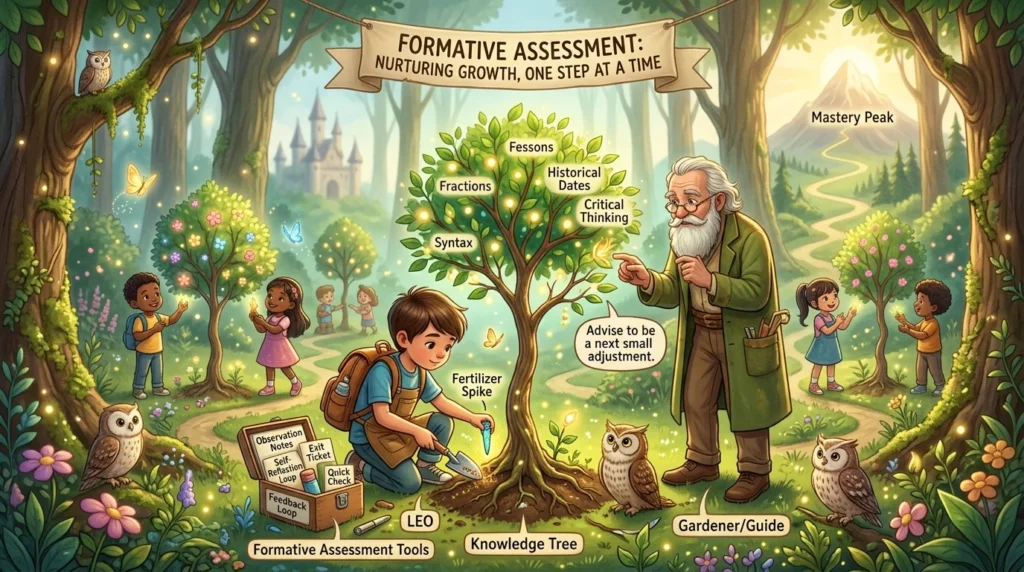
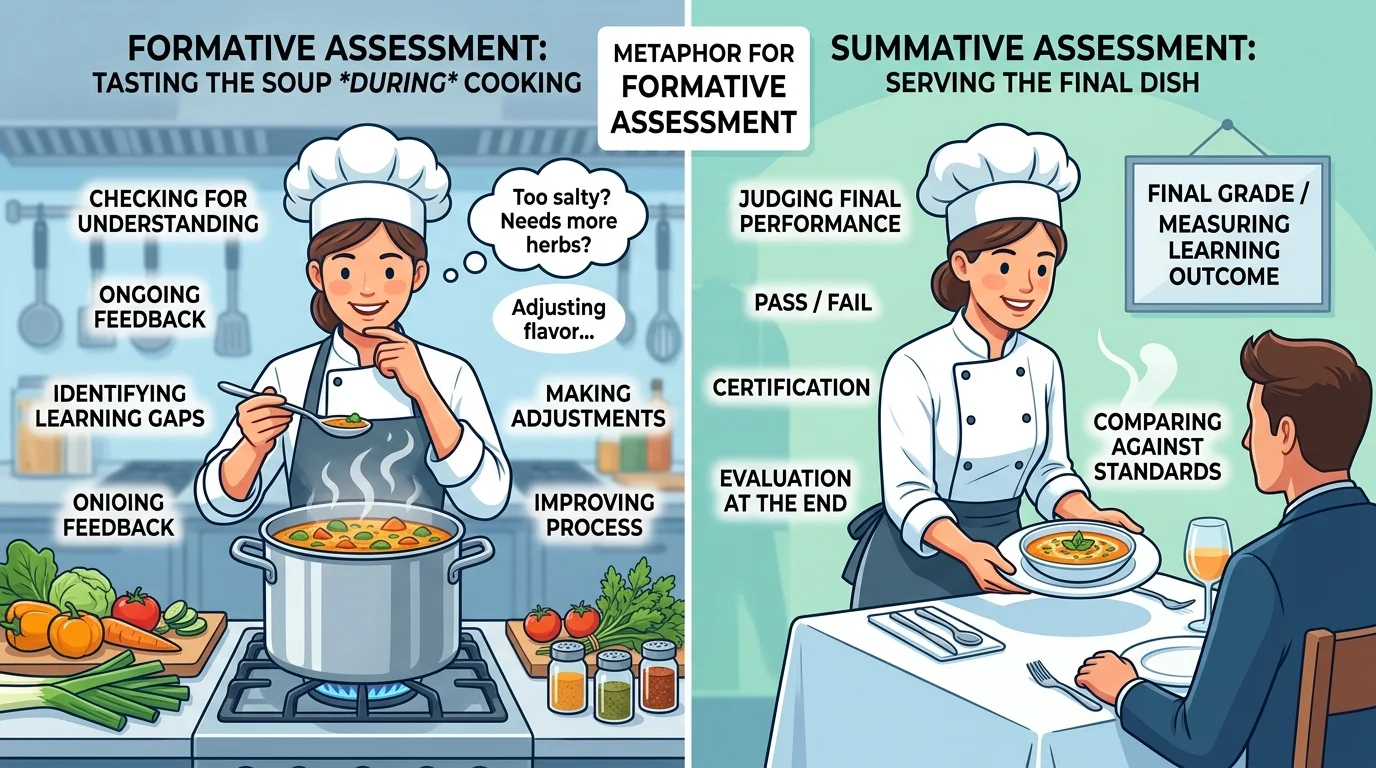
What Is a Metaphor for Formative Assessment?
A metaphor for formative assessment directly compares the process of checking learning progress to something that guides, measures, or improves a journey.
For example:
“Formative assessment is a GPS for learning.”
The assessment is not literally a GPS. The metaphor shows that it provides information during the learning process and helps learners change direction when needed.
Quick Answer
One of the best metaphors is:
“Formative assessment is a GPS for learning.”
It helps teachers and students see where they are, recognize when they are off track, and adjust before reaching the final destination.
Why Use a Metaphor for Formative Assessment?
Formative assessment can sound technical, especially to students, parents, or new teachers. A metaphor makes the concept easier to visualize.
It helps explain that formative assessment:
- Happens during learning
- Provides feedback
- Identifies strengths and gaps
- Supports improvement
- Guides the next steps
- Does not simply judge final performance
Instead of saying:
“Formative assessment provides ongoing feedback.”
You could say:
“Formative assessment is a flashlight that shows learners where to step next.”
The image makes the purpose easier to remember.
Best Metaphors for Formative Assessment
| Metaphor | What It Represents |
|---|---|
| GPS | Guidance and course correction |
| Compass | Direction during learning |
| Mirror | Reflection on current performance |
| Flashlight | Revealing gaps and next steps |
| Thermometer | Checking current progress |
| Coach | Giving feedback for improvement |
| Practice field | Learning through improvement |
| Bridge | Connecting current learning to goals |
| Road map | Showing the learning journey |
| Checkpoint | Monitoring progress along the way |
Formative Assessment as a GPS
“Formative assessment is a GPS for learning.”
This is one of the strongest and easiest metaphors to understand.
A GPS:
- Shows your current location.
- Helps you find your destination.
- Notices when you go off course.
- Suggests a new route.
Formative assessment does something similar in learning.
Example
“Exit tickets act as a GPS, showing the teacher where students are and where the lesson needs to go next.”
Formative Assessment as a Compass
“Formative assessment is a compass that keeps learning moving in the right direction.”
A compass provides direction rather than a final judgment.
Example
“Teacher feedback became a compass, helping students find their way through difficult concepts.”
This metaphor works well when discussing guidance and learning goals.
Formative Assessment as a Mirror
“Formative assessment is a mirror that reflects what learners understand right now.”
A mirror does not change a person. It simply shows what is currently there.
Similarly, formative assessment helps learners see:
- What they understand
- What they need to improve
- Where misconceptions exist
- What they should do next
Example
“A quick quiz can serve as a mirror, reflecting the student’s current understanding.”
Formative Assessment as a Flashlight
“Formative assessment is a flashlight that reveals the next step in learning.”
A flashlight helps people see what might otherwise remain hidden.
Example
“The teacher’s questions acted as a flashlight, revealing misconceptions before they became larger problems.”
This is especially useful when discussing feedback and learning gaps.
Formative Assessment as a Thermometer
“Formative assessment is a thermometer for learning.”
A thermometer measures the current condition rather than giving a final judgment.
Likewise, formative assessment checks:
- Current understanding
- Learning progress
- Areas of difficulty
- Readiness for the next lesson
Example
“The short quiz was a thermometer that measured the class’s understanding before the teacher moved forward.”
Formative Assessment as a Coach
“Formative assessment is a coach beside the learner.”
A coach watches performance, identifies weaknesses, and gives advice for improvement.
Example
“Constructive feedback became a coach, helping students strengthen their writing before the final assignment.”
Formative Assessment as a Checkpoint
“Formative assessment is a checkpoint on the road to learning.”
A checkpoint allows someone to stop, examine progress, and continue with better information.
Example
“Each classroom discussion became a checkpoint where students could test their understanding.”
Creative Metaphors for Formative Assessment
Here are several original ideas:
- Formative assessment is a GPS that recalculates the learning route.
- It is a compass in the middle of the learning journey.
- It is a mirror that shows what students understand today.
- It is a flashlight shining on the next step.
- It is a thermometer measuring the temperature of understanding.
- It is a coach offering advice before the final game.
- It is a checkpoint before the finish line.
- It is a bridge between mistakes and improvement.
- It is a practice field where learning gets stronger.
- It is a conversation between where students are and where they need to go.
Simple Metaphors for Formative Assessment
For presentations, essays, or classroom explanations, try:
- Formative assessment is a GPS for learning.
- Formative assessment is a compass.
- Formative assessment is a mirror.
- Formative assessment is a flashlight.
- Formative assessment is a thermometer.
- Formative assessment is a coach.
- Formative assessment is a checkpoint.
- Formative assessment is a road map.
- Formative assessment is a bridge.
- Formative assessment is a practice field.
Metaphors for Formative Assessment in Education
For Teachers
“Formative assessment is a teacher’s GPS, helping instruction change when students need a different route.”
For Students
“Formative assessment is a mirror that helps students see what they understand and what they still need to learn.”
For a Presentation
“Formative assessment is not the finish line; it is the road sign that helps learners reach it.”
For Professional Development
“Formative assessment is a conversation between evidence and action.”
For an Essay
“Formative assessment acts as a compass, guiding teaching and learning through continuous feedback.”
Formative Assessment vs. Summative Assessment Through Metaphors
The difference becomes easier to understand through comparison.
| Formative Assessment | Summative Assessment |
|---|---|
| GPS during the journey | Final destination report |
| Practice game | Championship game |
| Coach’s feedback | Final score |
| Checkpoint | Finish line |
| Mirror during learning | Final photograph |
Simple Comparison
“Formative assessment helps you improve during the journey, while summative assessment shows how you performed at the end.”
This is why the GPS metaphor works particularly well for formative assessment.
How to Choose the Best Metaphor for Formative Assessment
Choose GPS for Guidance
Use GPS when explaining course correction and adjusting teaching.
Choose a Mirror for Reflection
Use mirror when focusing on student self-awareness.
Choose a Flashlight for Learning Gaps
Use flashlight when discussing misconceptions or hidden areas of difficulty.
Choose a Coach for Feedback
Use coach when explaining support and improvement.
Choose a Thermometer for Progress Monitoring
Use thermometer when measuring current understanding.
Choose a Checkpoint for Ongoing Learning
Use checkpoint when emphasizing that assessment happens throughout the journey.
Common Mistakes When Explaining Formative Assessment
Treating It Like a Final Grade
Formative assessment is mainly used to support learning while it is happening.
Focusing Only on Tests
Formative assessment can include:
- Questions
- Classroom discussions
- Exit tickets
- Draft feedback
- Observations
- Peer feedback
- Self-assessment
Forgetting the Next Step
Assessment information becomes formative when it helps guide what happens next.
A useful metaphor is:
“Data without action is a map that nobody reads.”
Best Metaphor for Formative Assessment
If you need one clear and versatile option, use:
“Formative assessment is a GPS for learning.”
For reflection:
“Formative assessment is a mirror.”
For guidance:
“Formative assessment is a compass.”
For identifying gaps:
“Formative assessment is a flashlight.”
For improvement:
“Formative assessment is a coach.”