

What Is a Metaphor for Language Learning?
A metaphor for language learning directly compares the process of learning a language to another experience, object, or activity.
For example:
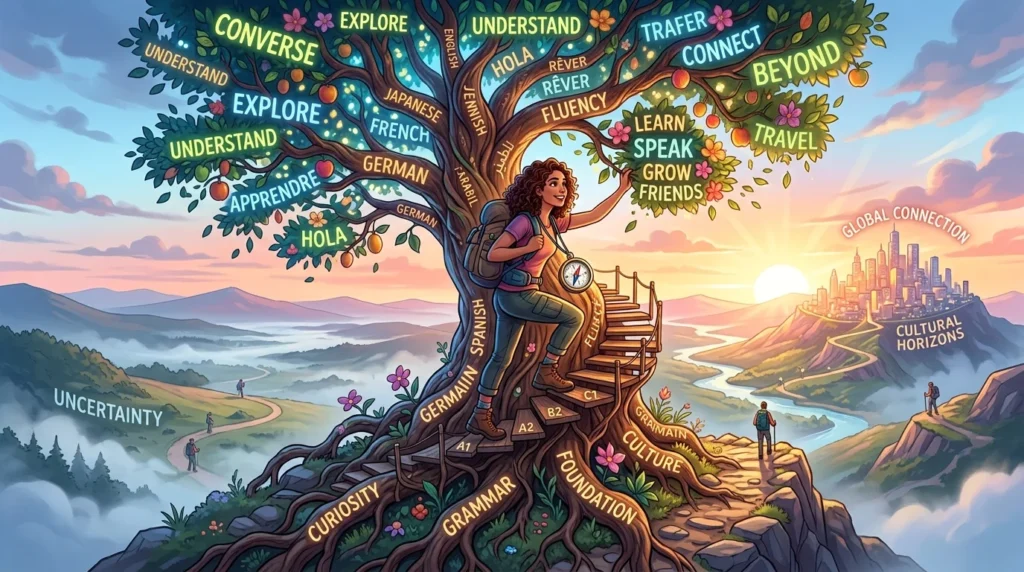
“Learning a language is climbing a mountain.”
This suggests that the process can be difficult, requires effort, and becomes more rewarding as you make progress.
Quick Answer
One of the best metaphors is:
“Learning a language is building a bridge.”
It represents communication and connection between different people and cultures.
Other strong options include:
- Climbing a mountain
- Growing a garden
- Building a house
- Solving a puzzle
- Opening a door
- Collecting keys
- Learning an instrument
- Crossing a river
Best Metaphors for Language Learning
| Metaphor | Meaning |
|---|---|
| Building a bridge | Connecting people and cultures |
| Climbing a mountain | Overcoming challenges gradually |
| Growing a garden | Developing through patience and care |
| Building a house | Creating knowledge step by step |
| Solving a puzzle | Connecting words and grammar |
| Opening a door | Accessing new opportunities |
| Collecting keys | Unlocking understanding with vocabulary |
| Learning an instrument | Improving through repeated practice |
| Crossing a river | Moving from unfamiliarity to confidence |
| Walking a path | Making gradual progress |
Language Learning as Building a Bridge
“Learning a language is building a bridge to another world.”
This is one of the most meaningful metaphors because language allows people to communicate beyond cultural and linguistic boundaries.
Example
“Every new word was another plank in the bridge connecting her to a new culture.”
A bridge metaphor works well for:
- Essays
- Speeches
- Cultural discussions
- Inspirational writing
Language Learning as Climbing a Mountain
“Learning a language is climbing a mountain.”
At the beginning, the mountain may look difficult. Progress can feel slow, but every step takes the learner higher.
Example
“Grammar felt like a steep mountain, but every lesson brought him closer to the summit.”
This metaphor is ideal for describing:
- Challenges
- Persistence
- Slow progress
- Achievement
Language Learning as Growing a Garden
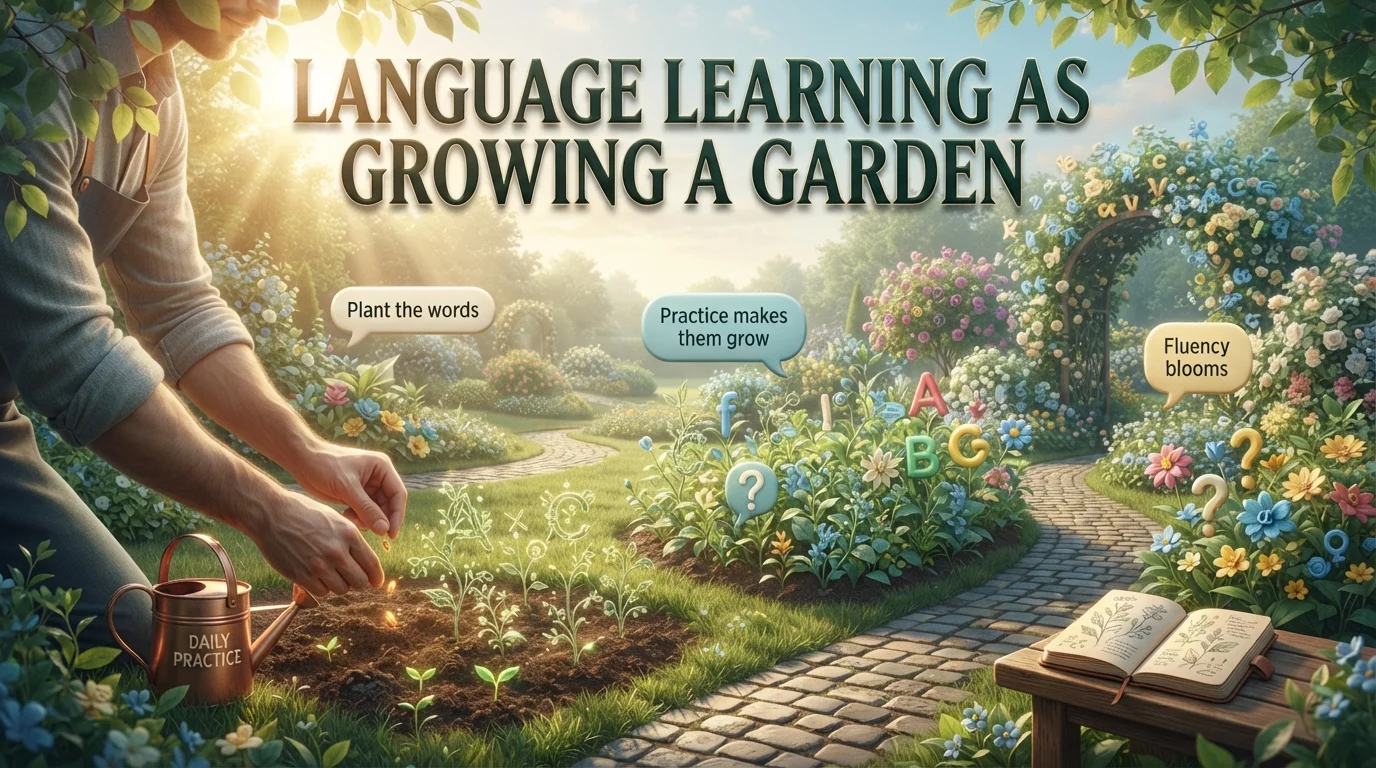
“Learning a language is growing a garden.”
A garden does not grow overnight. It needs regular care, water, sunlight, and patience.
Language learning works similarly. Vocabulary and confidence grow through regular practice.
Example
“She watered her language skills every day with reading, listening, and conversation.”
This is an excellent metaphor for consistency and patience.
Language Learning as Building a House
“Learning a language is building a house brick by brick.”
Every new word, grammar rule, and conversation adds something to the learner’s knowledge.
Example
“Each vocabulary word was another brick in the house of his new language.”
You can think of the process like this:
- Vocabulary = bricks
- Grammar = foundation
- Practice = construction
- Fluency = the completed home
Language Learning as Solving a Puzzle
“Learning a language is solving a giant puzzle.”
At first, words, grammar rules, and sounds may seem disconnected. Gradually, the pieces begin to fit together.
Example
“At first, the grammar rules were scattered puzzle pieces, but eventually they formed a clear picture.”
This metaphor works especially well for explaining how understanding develops over time.
Language Learning as Opening a Door
“Learning a language is opening a door to another world.”
Every language gives access to new people, stories, media, ideas, and experiences.
Example
“With every phrase she learned, another door opened into a culture she could finally understand more deeply.”
Language Learning as Collecting Keys
“Every new word is a key.”
Vocabulary gives learners the ability to unlock meaning.
Example
“He collected vocabulary like keys, and each new word unlocked another conversation.”
This is one of the best metaphors specifically for learning vocabulary.
Language Learning as Learning an Instrument
“Learning a language is learning to play an instrument.”
Reading instructions is not enough. You need regular practice.
Example
“She treated pronunciation like music, practicing the difficult sounds until they became natural.”
This metaphor highlights:
- Repetition
- Practice
- Muscle memory
- Gradual improvement
Creative Metaphors for Language Learning
Here are some original and creative ideas:
- Learning a language is building a bridge between two worlds.
- Every new word is a key to another door.
- Grammar is the skeleton holding language together.
- Vocabulary is the toolbox of communication.
- Pronunciation is the music of language.
- Conversation is where language learns to walk.
- Mistakes are stepping stones across the river of fluency.
- A new language is a map to an unfamiliar world.
- Fluency is a river that becomes smoother with practice.
- Language learning is planting a second voice inside your mind.
Poetic Metaphors for Language Learning
For poems, stories, and creative writing:
- A new language is a window opening toward another horizon.
- Words are stars, and learning connects them into constellations.
- Every sentence is a bridge made from sound and meaning.
- Language learning is planting a second voice inside the mind.
- Every mistake is a footprint on the road to fluency.
- Vocabulary is a garden that grows with every season.
- A language is a river, and practice teaches you how to swim.
- New words are lanterns in an unfamiliar city.
- Grammar is the architecture of thought.
- Fluency is a song that becomes easier every time you sing it.
Simple Metaphors for Language Learning
Here are easy examples:
- Learning a language is building a bridge.
- Learning a language is climbing a mountain.
- Learning a language is growing a garden.
- Learning a language is solving a puzzle.
- Learning a language is building a house.
- Learning a language is opening a door.
- Learning a language is walking a path.
- Learning a language is learning an instrument.
- Every word is a key.
- Mistakes are stepping stones.
Metaphors for Different Parts of Language Learning
| Part of Learning | Metaphor |
|---|---|
| Vocabulary | A toolbox |
| Grammar | A foundation |
| Pronunciation | Music |
| Listening | Tuning a radio |
| Speaking | Learning to dance |
| Reading | Opening a window |
| Writing | Building with words |
| Practice | Watering a garden |
| Mistakes | Stepping stones |
| Fluency | A flowing river |
Metaphor for Vocabulary
“Vocabulary is a toolbox.”
Words are the tools people use to communicate ideas.
Example
“Every new word added another useful tool to her communication toolbox.”
Another option is:
“Every word is a key.”
Words unlock conversations and understanding.
Metaphor for Grammar
“Grammar is the foundation of language.”
Just as a building needs a strong foundation, sentences need structure.
Example
“Vocabulary gave him the bricks, but grammar gave him the foundation to build meaningful sentences.”
Metaphor for Pronunciation
“Pronunciation is the music of language.”
Languages have rhythm, stress, melody, and patterns.
Example
“As she practiced speaking, she began to hear the music inside the language.”
Metaphor for Making Mistakes
“Mistakes are stepping stones to fluency.”
Mistakes can show learners where they need more practice.
Example
“Instead of fearing mistakes, he used them as stepping stones toward greater confidence.”
Metaphor for Practice
“Practice is water for the garden of language.”
Without regular practice, skills may stop growing.
Example
“A few minutes of practice every day watered the garden of her language skills.”
Metaphor for Fluency
“Fluency is a river.”
At first, speaking may feel slow and broken. With practice, words begin to flow more naturally.
Example
“After months of practice, her sentences stopped arriving one by one and began flowing like a river.”
Metaphor for Language Learning in an Essay
You could write:
“Learning a new language is like building a bridge. Every word and phrase becomes another piece of the structure, allowing us to cross from unfamiliarity toward understanding.”
Another option:
“Language learning is a mountain climbed one step at a time. The path may be difficult, but every small achievement offers a wider view.”
Metaphor for Language Learning in a Speech
“Learning another language is not simply memorizing words. It is building a bridge strong enough to carry your thoughts into another world.”
Or:
“Every mistake proves that you are moving. No one crosses a river by standing safely on the shore.”
How to Choose the Right Metaphor for Language Learning
For Connection
Use:
“Building a bridge.”
For Difficulty
Use:
“Climbing a mountain.”
For Patience
Use:
“Growing a garden.”
For Building Knowledge
Use:
“Building a house.”
For Vocabulary
Use:
“Collecting keys.”
For Practice
Use:
“Learning an instrument.”
For Mistakes
Use:
“Stepping stones.”
For Fluency
Use:
“A flowing river.”
Common Mistakes When Using Language-Learning Metaphors
Expecting Instant Fluency
Language learning is usually gradual. Metaphors like climbing a mountain and growing a garden better represent the process.
Seeing Mistakes as Failure
Mistakes are part of learning.
A stronger way to describe them is:
“Mistakes are stepping stones.”
They help learners move forward.
Using Too Many Metaphors
Avoid writing:
“Learning a language is a bridge, mountain, garden, puzzle, house, river, and instrument.”
Choose one main metaphor and develop it clearly.
Best Metaphor for Language Learning
If you need one versatile answer, use:
“Learning a language is building a bridge to another world.”
For challenges:
“Learning a language is climbing a mountain.”
For gradual improvement:
“Learning a language is growing a garden.”
For vocabulary:
“Every new word is a key.”
For mistakes:
“Mistakes are stepping stones to fluency.”
For fluency:
“Fluency is a river that becomes smoother with practice.”