
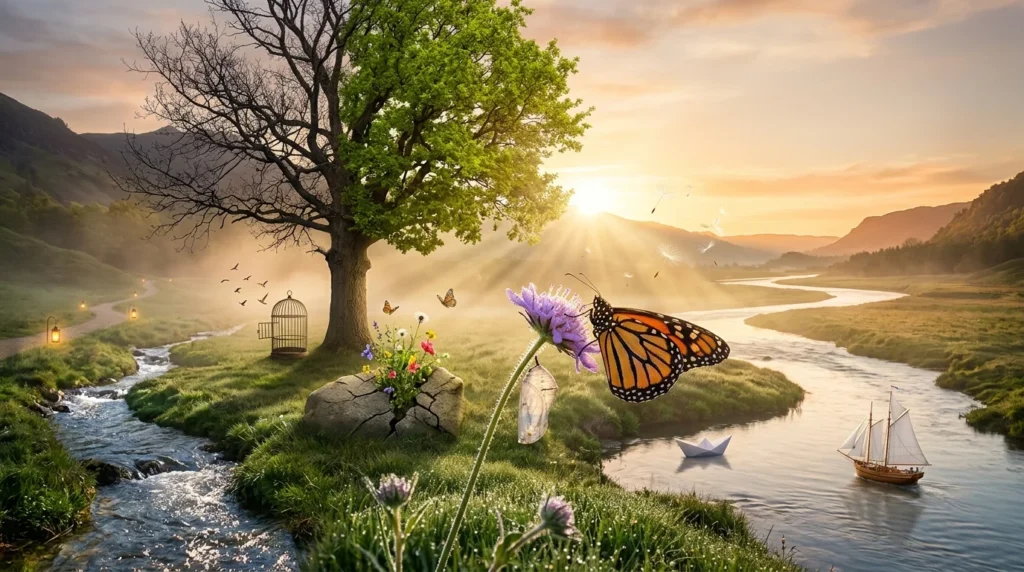
Change is one of life’s few constants, yet describing it can be surprisingly difficult. Whether you’re writing a poem, giving a speech, crafting a story, or simply trying to express how life has shifted, finding the right metaphor for change can make your words more vivid and memorable.
Metaphors help us understand complex ideas by comparing them to something familiar. Instead of saying someone “changed,” you might say they “spread their wings” or “turned the page.” These images instantly create emotion and meaning that plain language often cannot.
In this guide, you’ll discover what a metaphor for change is, why it works, and more than 150 creative examples organized by theme. You’ll also learn how to choose the right metaphor for different situations, avoid common mistakes, and use figurative language naturally in your writing.
Let’s explore the many ways to describe transformation, growth, and new beginnings.
What Is a Metaphor for Change?
Quick Answer: A metaphor for change is a figurative comparison that describes transformation by relating it to another object, event, or experience without using “like” or “as.”
Instead of saying:
She changed after college.
You could write:
She became a butterfly leaving its cocoon.
The second sentence creates a stronger mental image and conveys personal growth in a memorable way.
Why Writers Use Metaphors for Change
Quick Answer: Metaphors make change easier to visualize, more emotionally engaging, and more memorable than literal descriptions.
They help readers:
- Picture transformation clearly
- Connect emotionally with the message
- Understand abstract ideas
- Remember key points
- Experience stories more vividly
Whether you’re writing fiction, speeches, essays, or social media posts, metaphors can add depth without making your writing difficult to understand.
Common Types of Change
Different situations call for different metaphors. Here are some of the most common forms of change.
| Type of Change | Example Situation |
|---|---|
| Personal growth | Becoming more confident |
| Career change | Starting a new job |
| Emotional change | Healing after loss |
| Relationship change | Moving on after a breakup |
| Lifestyle change | Building healthier habits |
| Seasonal change | Beginning a new chapter |
| Organizational change | Company restructuring |
| Creative change | Finding a new perspective |
Nature Metaphors for Change
Quick Answer: Nature offers some of the strongest metaphors because it constantly demonstrates transformation.
Here are inspiring examples:
- A butterfly leaving its cocoon
- A river carving a new path
- Spring replacing winter
- A tree shedding old leaves
- A flower opening to the sun
- A seed breaking through the soil
- Fresh rain washing away dust
- The changing tides
- A sunrise after darkness
- The moon changing phases
- Melting snow
- A rainbow after the storm
- New roots taking hold
- Branches reaching toward light
- A forest growing after fire
- Waves reshaping the shore
- Clouds parting
- Morning dew appearing
- Blossoms unfolding
- Fresh grass after rain
Journey Metaphors for Change
Travel naturally symbolizes life’s transitions.
Popular examples include:
- Turning the page
- Crossing a bridge
- Reaching a crossroads
- Beginning a new chapter
- Opening a new door
- Choosing another path
- Setting sail
- Climbing a mountain
- Walking toward the horizon
- Following a compass
- Leaving the station
- Changing tracks
- Taking the first step
- Finding a new direction
- Discovering a hidden trail
- Navigating rough waters
- Rewriting the map
- Building a new road
- Stepping into unknown territory
- Starting a fresh adventure
Growth Metaphors for Change
Growth often happens gradually, making these metaphors especially meaningful.
Examples include:
- Growing new branches
- Sharpening the blade
- Forged in fire
- Polishing a diamond
- Building stronger foundations
- Stretching new roots
- Learning to fly
- Rewriting the script
- Becoming taller than yesterday
- Blooming where planted
- Filling new shoes
- Finding your wings
- Expanding your horizons
- Breaking old chains
- Becoming a stronger tree
Renewal Metaphors for Change
Renewal emphasizes fresh beginnings and second chances.
Examples include:
- A clean slate
- Hitting refresh
- Turning over a new leaf
- Starting with a blank canvas
- A fresh coat of paint
- Phoenix rising from the ashes
- Dawn after darkness
- Spring after winter
- New life after the rain
- Lighting a new candle
- Opening fresh windows
- A new heartbeat
- Fresh air filling the room
- A second sunrise
- A reborn garden
Powerful Metaphors for Personal Change
Quick Answer: Personal change is often best expressed through images of growth, renewal, and discovery.
Examples:
- Becoming your own compass
- Breaking free from invisible chains
- Learning to dance in the rain
- Finding your true north
- Becoming the author of your story
- Trading armor for confidence
- Building a stronger foundation
- Discovering hidden wings
- Becoming the captain of your ship
- Walking into the light
Metaphors for Positive Change
Use these when describing success, hope, or improvement.
- Sunshine after rain
- A garden in bloom
- The dawn of a new day
- Opening new doors
- A rising tide
- Fresh wind in the sails
- Climbing above the clouds
- Lighting the path forward
- New roots growing deeper
- A brighter horizon
Metaphors for Difficult Change
Not every transformation is easy.
These metaphors acknowledge struggle while suggesting progress.
- Walking through fire
- Weathering the storm
- Crossing a rocky bridge
- Carrying a heavy backpack
- Breaking through thick ice
- Climbing a steep hill
- Sailing rough seas
- Emerging from the shadows
- A cracked shell revealing new life
- Forged in the furnace
Creative Metaphors for Everyday Writing
Here are modern and imaginative choices.
- Updating the software
- Switching gears
- Changing the channel
- Flipping the switch
- Resetting the compass
- Turning the kaleidoscope
- Installing a new foundation
- Opening another window
- Rebooting the engine
- Starting a fresh playlist
How to Choose the Right Metaphor for Change
Quick Answer: The best metaphor depends on your audience, purpose, and emotional tone.
Ask yourself:
- Is the change positive or difficult?
- Is your audience formal or casual?
- Do you want inspiration or realism?
- Should the image feel calm or dramatic?
- Will readers easily understand the comparison?
A simple, familiar metaphor often has more impact than an overly complicated one.
Common Mistakes to Avoid
When using metaphors, keep these tips in mind:
- Don’t mix unrelated metaphors in the same sentence.
- Avoid clichés when originality matters.
- Match the metaphor to the tone of your writing.
- Keep comparisons clear and easy to understand.
- Don’t overuse metaphors in every paragraph.
Strong metaphors enhance writing, but too many can distract readers.
Best Practices for Using Metaphors
Follow these guidelines for natural writing:
- Choose familiar images.
- Keep the comparison consistent.
- Focus on one main idea.
- Use sensory language when possible.
- Read your sentence aloud to check its flow.
- Revise until the metaphor feels effortless.
Quick Reference: Popular Metaphors for Change
| Metaphor | Meaning |
|---|---|
| Butterfly | Personal transformation |
| Sunrise | New beginning |
| River | Continuous change |
| Bridge | Transition |
| Seed | Growth and potential |
| Phoenix | Renewal after hardship |
| Spring | Fresh start |
| Compass | New direction |
| Tree | Steady development |
| Ocean tide | Natural cycles of life |
Frequently Asked Questions
What is the best metaphor for change?
A butterfly emerging from its cocoon is one of the most widely recognized metaphors because it symbolizes growth, transformation, and new beginnings.
What is a metaphor for personal growth?
Common metaphors include growing roots, climbing a mountain, blooming like a flower, or turning the page to a new chapter.
Why are metaphors effective?
Metaphors help readers visualize abstract ideas, making writing more engaging, memorable, and emotionally meaningful.
What’s the difference between a metaphor and a simile?
A metaphor states that one thing is another, while a simile compares two things using “like” or “as.”
Can metaphors improve creative writing?
Yes. Strong metaphors create vivid imagery, deepen emotional impact, and make stories and essays more compelling.
Are metaphors useful in speeches?
Absolutely. Memorable metaphors make speeches easier to understand and help audiences remember key ideas.
How can I create my own metaphor?
Start with the emotion or idea you want to express, then compare it to something familiar that shares similar qualities.
Should I use many metaphors in one piece?
No. A few well-chosen metaphors usually have more impact than using one in every sentence.
Conclusion
A well-chosen metaphor for change can transform ordinary writing into something memorable. Whether you describe change as a butterfly leaving its cocoon, a river finding a new course, a sunrise after darkness, or a bridge leading to new possibilities, the right metaphor helps readers connect with ideas on a deeper level.
The most effective metaphors are simple, relatable, and appropriate for the message you want to share. By choosing images that reflect growth, resilience, renewal, or fresh beginnings, you can communicate change with clarity and emotion. The next time you write about transformation, let your words paint a picture that readers will remember long after they finish reading.