

What Is a Metaphor for Something Repeating?
A metaphor for something repeating compares repeated actions or events to an object, movement, or natural process that returns again and again.
For example:
“The conversation was a broken record.”
The conversation is not literally a record. The metaphor suggests that the same words or ideas keep being repeated.
Other useful metaphors include:
- A revolving door
- A spinning wheel
- A repeating loop
- An echo
- A recurring tide
- A boomerang
- A carousel
- A clock
- A cycle
- A scratched record
25 Metaphors for Something Repeating
1. A Broken Record
“His complaints were a broken record.”
A broken record metaphorically represents something that repeats the same message over and over.
It is especially useful for annoying or unnecessary repetition.
2. A Loop
“We were trapped in a loop.”
A loop returns to its starting point, making it an excellent metaphor for repeated situations.
It can describe conversations, mistakes, thoughts, or behaviors.
3. A Revolving Door
“The same problems kept coming through the revolving door.”
A revolving door constantly returns people to the same place.
This metaphor works well when events keep happening without producing meaningful change.
4. A Spinning Wheel
“Their arguments were a spinning wheel, always returning to the same point.”
A spinning wheel suggests continuous movement without necessarily making progress.
5. An Echo
“The same excuse was an echo from last year.”
An echo repeats a sound after it has already been made.
This metaphor works particularly well for words, opinions, or behaviors that keep resurfacing.
6. A Boomerang
“The problem was a boomerang; every time we thought it was gone, it came back.”
A boomerang represents something that returns after appearing to disappear.
7. A Carousel
“Their routine felt like a carousel, endlessly circling the same path.”
A carousel moves continuously but returns to the same places.
This metaphor can describe repetitive routines or situations.
8. A Ticking Clock
“The same deadline arrived like a ticking clock.”
A clock represents recurring time and predictable repetition.
9. The Turning Seasons
“Life moved like the seasons, always returning in a familiar rhythm.”
The changing seasons provide a natural metaphor for recurring patterns.
This image is usually more peaceful than a broken-record metaphor.
10. A Returning Tide
“The memories came back like a returning tide.”
Tides repeatedly move toward and away from shore.
This is especially effective for recurring thoughts, emotions, or memories.
11. Footprints in the Same Sand
“He kept leaving the same footprints in the sand.”
This metaphor suggests repeating the same actions or making the same choices.
12. A Record Stuck on One Track
“The discussion was a record stuck on one track.”
This represents repetitive conversation or thinking.
13. A Snake Chasing Its Tail
“Their argument was a snake chasing its tail.”
The image suggests a circular process that never reaches a meaningful conclusion.
14. A Wheel Going Around
“The project felt like a wheel going around without moving forward.”
This metaphor emphasizes repetition without progress.
15. A Pendulum
“His mood swung like a pendulum.”
A pendulum repeatedly moves from one side to another.
This metaphor is useful for alternating patterns.
16. A Daily Drumbeat
“The same routine became the daily drumbeat of her life.”
A drumbeat repeats a steady rhythm, making it a good metaphor for predictable routines.
17. A Rewound Film
“Every conversation felt like a film someone had rewound.”
The metaphor suggests that the same events or dialogue keep playing again.
18. A Spinning Top
“The discussion was a spinning top, moving constantly but going nowhere.”
This emphasizes repeated activity without meaningful progress.
19. A Circle With No Exit
“Their relationship had become a circle with no exit.”
The metaphor represents a pattern that continually returns to the same situation.
20. A Copy Machine
“Every meeting felt like a copy machine producing the same conversation.”
This metaphor works well for repetitive work or discussions.
21. A Rubber Band
“The argument was a rubber band that kept snapping back.”
The rubber band represents something that repeatedly returns after being stretched away.
22. A Train on the Same Track
“Their routine was a train traveling the same track every day.”
The train represents predictable repetition.
23. A Song on Repeat
“That thought was a song playing on repeat in my head.”
This is especially useful for recurring thoughts, memories, or worries.
24. A Clock’s Hands
“The same mistakes returned like the hands of a clock.”
Clock hands continuously travel around the same path.
25. A River Returning to Its Course
“No matter how far they wandered, the conversation returned to the same course.”
This metaphor suggests that a discussion or situation repeatedly returns to a familiar subject.
Metaphors for Something That Keeps Happening
When an event repeatedly occurs, these metaphors can make the pattern clearer.
A Boomerang
“The issue was a boomerang that kept coming back.”
Best for problems that seem solved but return.
A Revolving Door
“The same excuses came through the revolving door every week.”
Best for recurring behavior.
A Loop
“We were stuck in a loop of promises and disappointments.”
Best for repeated situations.
A Returning Tide
“The memories returned like the tide.”
Best for recurring emotions or memories.
Metaphors for Repeating Mistakes
Repeated mistakes often involve a sense of circular movement.
Running in Circles
“Making the same mistake was like running in circles.”
This suggests effort without progress.
A Wheel in Mud
“Their plan was a wheel spinning in mud.”
The wheel turns, but the vehicle does not move forward.
A Road With the Same Dead End
“They kept taking a road that ended at the same dead end.”
This metaphor emphasizes repeated choices with predictable consequences.
A Record on Repeat
“Every mistake sounded like the same record playing again.”
This is simple and conversational.
Metaphors for Repetitive Thoughts
Some repetition happens inside the mind.
A Song on Repeat
“The memory was a song stuck on repeat in my mind.”
An Echo Chamber
“The same thought became an echo chamber in his head.”
A Spinning Wheel
“Her thoughts were a spinning wheel that never stopped.”
A Broken Record
“His doubts sounded like a broken record.”
These metaphors work well in personal essays, poetry, and reflective writing.
Metaphors for Repetitive Behavior
When someone repeatedly does the same thing, you can use metaphors that emphasize habit.
| Metaphor | Meaning |
|---|---|
| Broken record | Repeating the same words |
| Loop | Returning to the same situation |
| Revolving door | Repeated arrivals or departures |
| Carousel | Circling through the same pattern |
| Boomerang | Something that repeatedly returns |
| Pendulum | Repeated movement between two extremes |
| Spinning wheel | Activity without progress |
| Daily drumbeat | Predictable routine |
| Train on the same track | Following the same pattern |
| Song on repeat | Recurring thought or event |
Metaphors for Something Repeating Without Progress
Sometimes repetition is not merely recurrence—it means being stuck.
A Hamster Wheel
“The routine had become a hamster wheel.”
A hamster wheel represents constant activity without meaningful advancement.
A Car Stuck in Neutral
“We were a car stuck in neutral, making noise without going anywhere.”
This metaphor clearly communicates effort without progress.
A Wheel Spinning in Mud
“Their plans were wheels spinning in mud.”
This suggests repeated effort that fails to create movement.
A Maze With No Exit
“The same problem was a maze with no exit.”
This represents a recurring challenge that seems impossible to escape.
Metaphors for Positive Repetition
Not all repetition is negative. Repeated actions can create stability, skill, and tradition.
A Daily Drumbeat
“Practice became the daily drumbeat behind her success.”
A Steady Clock
“His routine was a steady clock keeping his days on track.”
The Turning Seasons
“Their annual tradition returned like the turning seasons.”
A Familiar Melody
“Her morning routine was a familiar melody.”
These metaphors give repetition a comforting or productive feeling.
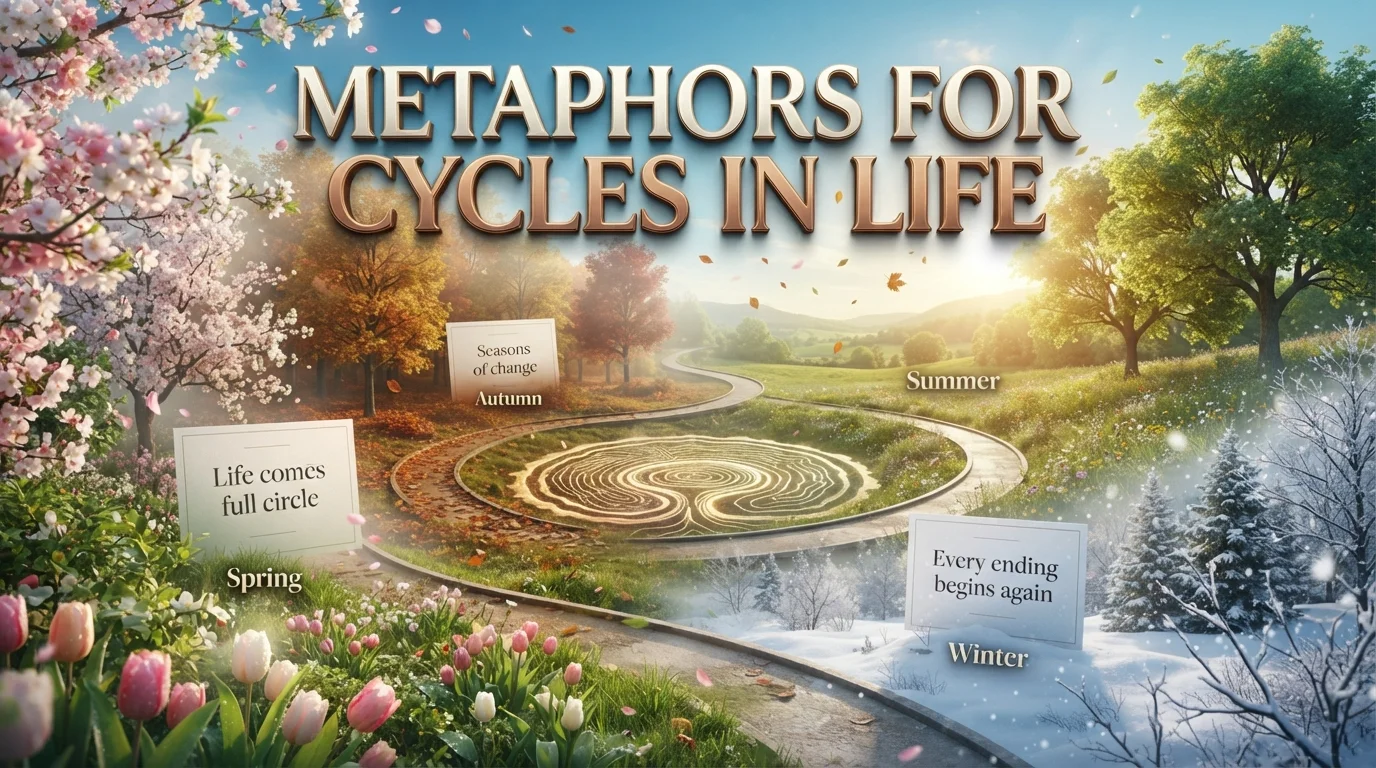
Metaphors for Cycles in Life
Life naturally contains repeating patterns.
The Seasons
“Life moves through seasons, each one eventually returning in another form.”
A Wheel
“Life is a wheel, constantly turning through familiar stages.”
A Tide
“Life moves like a tide, coming and going in rhythms we cannot always control.”
A Circle
“Some lessons return in circles until we finally understand them.”
These metaphors are useful for reflective and philosophical writing.
Repetition vs. Recurrence: Which Metaphor Should You Use?
The words repetition and recurrence are related, but they can carry different meanings.
| Situation | Useful Metaphor |
|---|---|
| Same words repeated | Broken record |
| Same problem returns | Boomerang |
| Same situation repeats | Loop |
| Natural recurring event | Seasons |
| Recurring memories | Returning tide |
| Repetitive routine | Daily drumbeat |
| Repeated effort without progress | Hamster wheel |
| Alternating behavior | Pendulum |
| Repeated circular pattern | Carousel |
| Repeated thought | Song on repeat |
Choosing the metaphor based on the type of repetition makes the writing more precise.
How to Create Your Own Metaphor for Something Repeating
You can create an original metaphor by identifying what repeats and how it repeats.
Step 1: Identify the Pattern
Ask:
- Does it return to the beginning?
- Does it alternate?
- Does it repeat exactly?
- Does it return after disappearing?
- Does it repeat without progress?
Step 2: Find a Familiar Image
Match the pattern to something people recognize.
For example:
Repeated return → boomerang
Circular movement → carousel
Alternating movement → pendulum
Repeated words → broken record
Step 3: Add the Meaning
Instead of saying:
“We kept having the same argument.”
Try:
“Our arguments were a broken record with a new date stamped on each one.”
The metaphor makes the repetitive pattern more memorable.
Common Mistakes When Using Repetition Metaphors
Using “Broken Record” for Everything
A broken record specifically works well when the same words or message are repeated. It may not be the best choice for every recurring event.
Confusing Repetition With Progress
A spinning wheel can suggest movement without progress, but not all repetition is unproductive.
Overcomplicating the Image
A simple metaphor such as “a song on repeat” may be stronger than an elaborate comparison that requires explanation.
Mixing Unrelated Metaphors
Try to keep the imagery consistent. Switching from a carousel to a river to a clock in the same sentence can weaken the comparison.